What is a domain and how to choose the right domain for your business?
A domain is often a client's first contact with your business. We explain what a domain is, the difference between a domain and hosting, .hr vs .com, and how to choose a good name.
Every business needs an address where customers can find it. While business premises have physical addresses, websites have internet addresses called domains. The domain is one of the first things people come across when they search online for your company, services or products.
Choosing a domain often seems like a simple step when building a website. However, a well-chosen name can play an important role in building your brand, presenting your business professionally and earning the trust of potential clients.
Your domain appears on business cards, in business email addresses, in ads and in Google search results. That is why it should be simple, recognisable and aligned with your business identity.
Although you can register a domain in just a few minutes today, before choosing it is worth understanding how domains work, how the various extensions differ and what to watch out for to avoid unnecessary complications later.
What is a domain and how does it work?
A domain is a unique internet address through which users can reach a specific website. For example, our agency's domain is webmindex.com. When someone types that address into a browser, the Webmindex website opens.
Behind this simple process is DNS (Domain Name System), which links domain names to the technical data needed to find the right server. Thanks to DNS, people do not have to remember complex IP addresses; they can reach websites simply by typing their names.
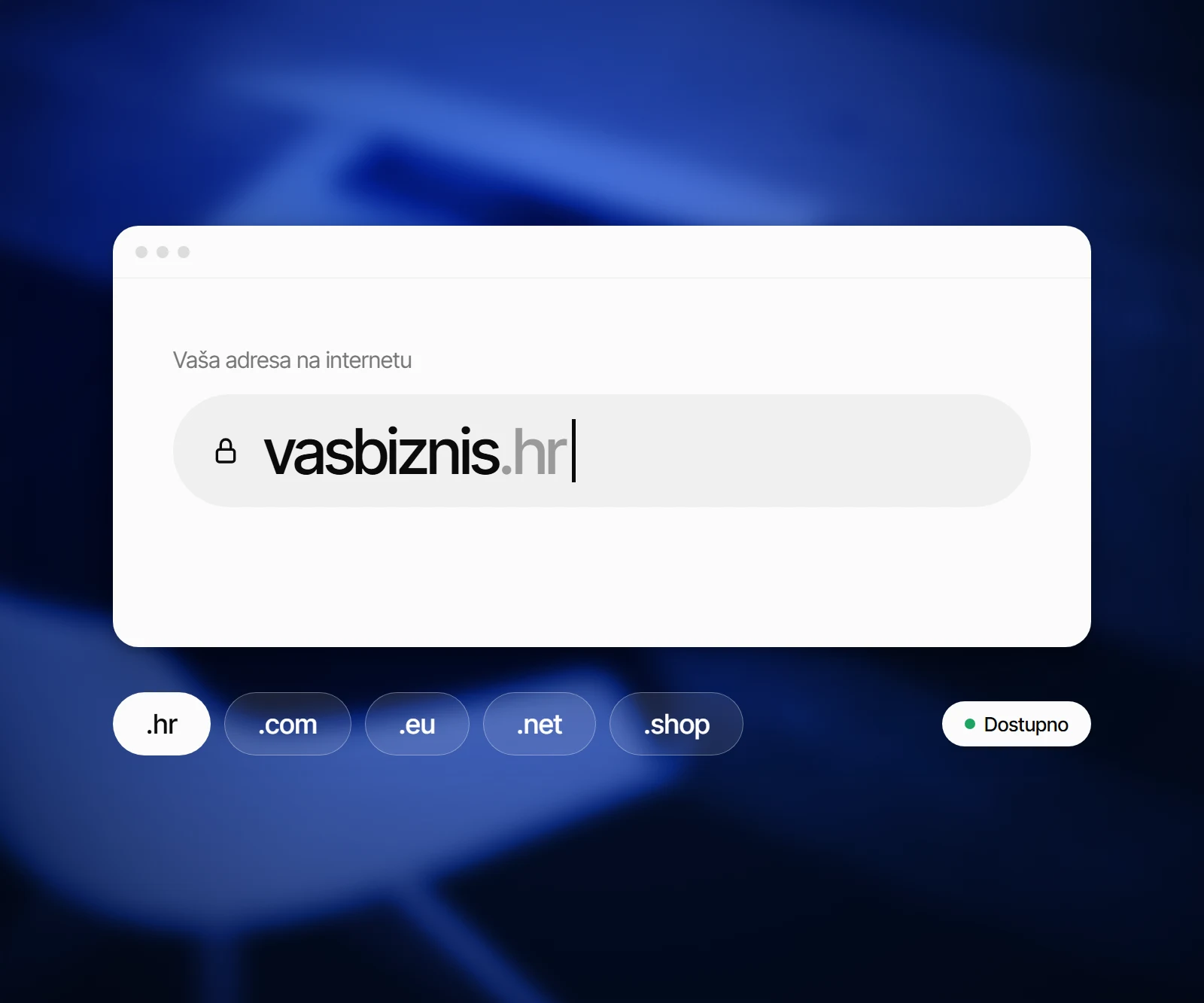
Every domain consists of a name and a domain extension. In webmindex.com, the name is webmindex, and .com is the extension, also called the top-level domain. Well-known extensions include .hr, .com, .net and .org, and many other options are available today.
It is important to understand that a domain on its own is not a website. It is the address visitors use to reach content stored on a server. This is where another important term comes in – web hosting.
A domain is your website's address, while hosting is the service that stores its files and keeps it available online. The simplest comparison is a business premises: the domain is its address, hosting is the space you use, and the website is what is inside.
Most standard business websites need both services, although they do not have to come from the same provider.
.hr or .com – which domain should you choose?
One of the most common questions when registering a domain is which extension to pick. For companies and sole traders operating in Croatia, the usual choices are .hr and .com, and the decision mainly depends on the market they target and their long-term plans.
The .hr domain is the national top-level domain of the Republic of Croatia. It is especially suitable for companies, sole traders and organisations that offer their products or services mainly to Croatian customers. It clearly signals a connection to the local market and can help build local recognition.
One of its advantages is free registration. Legal entities registered in Croatia and individuals running a registered independent business who meet the required conditions are entitled to one free .hr domain. The name must comply with the registration rules; details are available on the official domene.hr website.
On the other hand, .com is one of the best-known and most widely used extensions in the world. It is often used by international companies, digital agencies and brands active in several markets. Its advantages are broad recognition and the fact that it is not tied to any particular country.
If your company operates only in Croatia, .hr is usually a very good choice. However, if you plan to expand internationally, .com may be the more practical long-term solution.
When deciding, also consider visibility in search engines. National extensions like .hr can signal a connection to a particular country, but the extension alone does not guarantee better rankings on Google. Content quality, technical optimisation, relevance and user experience matter far more.
If both extensions are available, consider registering both domains. That way you also protect your brand name, using one domain as the main one and redirecting the other to it.
How to choose a good domain for your business?
A good domain does not have to be especially creative or unusual. It is far more important that it is simple, easy to remember and connected to your business.
The best starting point is the name of your company or brand. If you already trade under a recognisable name, using it in your domain keeps your communication consistent and makes it easy for people to connect your website with a business they already know.
Pay special attention to length. Short, clear domains are easier to remember, say and type, which matters when you share the address over the phone, on social media or in conversation with potential clients. Avoid unnecessarily long names, numbers and hyphens when a simpler alternative exists.
It is just as important to check whether the domain you want is available. The name you have in mind may already be registered, so you may need to consider another extension or adjust the name. Also check whether a company or registered trademark with the same or a very similar name already exists. A free domain does not necessarily mean that using it is legally unproblematic.
Think long-term when choosing. The domain you register today could represent your business for years. If you currently offer a single service but plan to expand, an overly specific name could limit you. The same applies to names that include a particular city or region if you might expand to other areas.
It is also important that the domain is registered to your company or to the person it truly belongs to. If an external contractor builds your website, make sure you have access to the registration details and can manage the domain yourself. That way you avoid depending on a third party for renewals, transfers or settings changes.
A good domain should be simple enough for people to remember after hearing it once, and distinctive enough to be associated with your business.
How much does a domain cost and what to watch out for when registering?
The price of a domain depends on the extension, the registrar and the registration period. While some businesses in Croatia may be entitled to a free .hr domain, most other domains are registered for a fee, usually on a yearly basis.
When comparing offers, the initial price is not enough. Some registrars offer a cheaper first year, while renewal can cost considerably more. It is wise to check renewal costs, the terms for transferring the domain to another registrar and whether you can manage DNS records yourself.
It is also important to understand that registering a domain is not a permanent purchase. It gives you the right to use it for a certain period, under the rules of the relevant registry. Paid domains must be renewed on time, while free ones follow special rules for renewal and keeping the right of use.
If a domain expires and is not renewed in time, you may lose the right to use it. After the relevant deadlines pass, it can become available for others to register. For business websites this can be a serious problem, because the domain is linked not only to the website but often to business email addresses too.
You can change the domain after the website is built, but it requires careful preparation. You need to set up proper redirects, update internal links and take care of SEO settings to reduce the risk of losing traffic and search rankings.
That is why choosing a good domain at the very start of your business is much simpler and more cost-effective in the long run than changing it later.
A good domain is the first step towards a quality website
Choosing a domain may seem like a small detail in the website building process, but it is a decision that can shape how recognisable your business is in the long run.
A simple, clear and professional domain makes it easier for people to find your website, supports consistent brand presentation and lays a good foundation for growing your online presence.
Still, the domain is only the beginning. To give potential clients a good user experience, reliable hosting, modern design, fast loading and content that clearly presents your products or services are just as important.
At Webmindex we build and maintain business websites, and help with choosing the domain, hosting and other technical solutions they need to run reliably.
If you are planning a new website or want to improve your current one, we can help you find the right solution for your business.